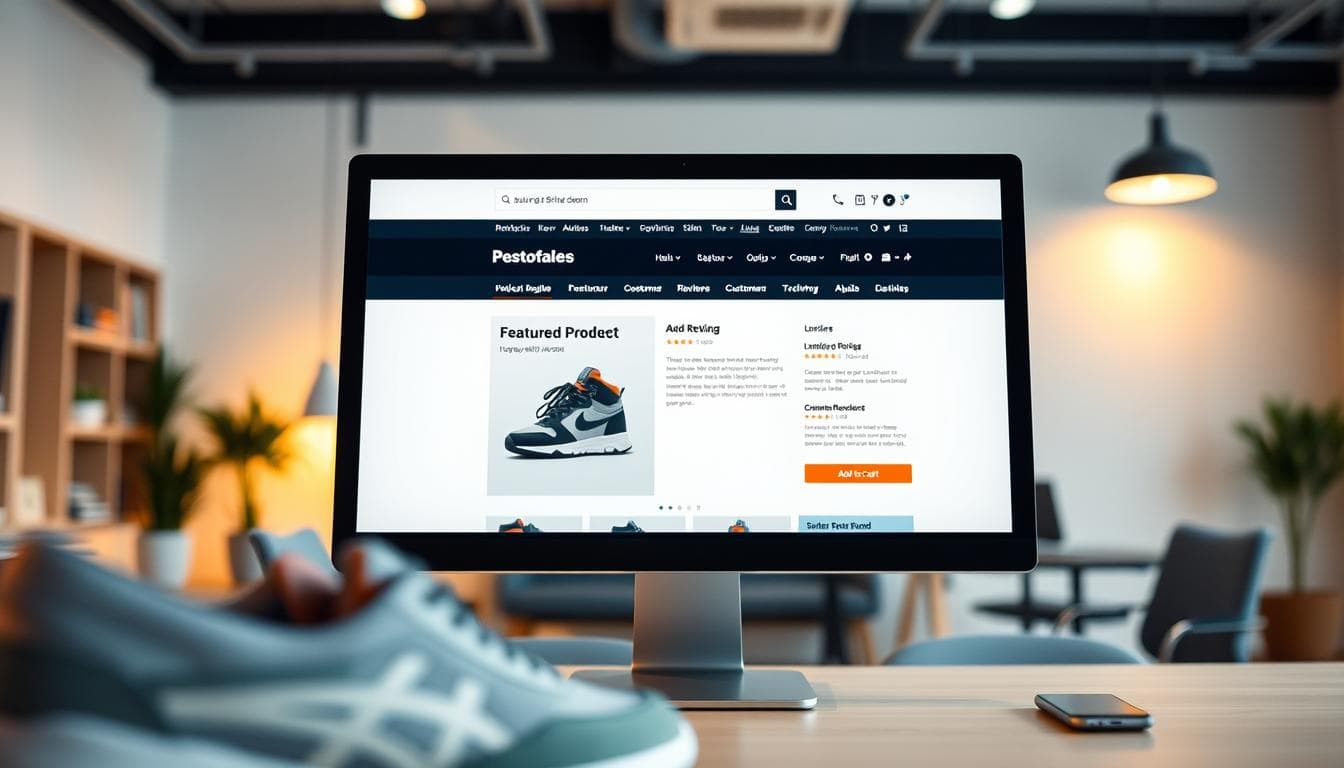
Boost Sales: Essential E-commerce Product Page Design Strategies
In the competitive world of e-commerce, a well-crafted product page is crucial for driving sales and conversions. A user-friendly ecommerce product page design can make all the difference in enhancing the shopping experience and encouraging customers to make a purchase.
Effective conversion rate optimization techniques play a vital role in achieving this goal. By streamlining the product page and focusing on user experience, businesses can significantly improve their bottom line.

A well-designed product page not only showcases products in an appealing manner but also provides customers with the necessary information to make informed purchasing decisions. This, in turn, fosters trust and loyalty, leading to increased sales and customer retention.
Key Takeaways
- Optimizing ecommerce product pages for better user experience
- Implementing effective conversion rate optimization techniques
- Enhancing product page design for increased sales
- Focusing on customer needs and preferences
- Streamlining the shopping experience for improved conversions
The Critical Role of Product Pages in E-commerce Success
The design and functionality of product pages are critical factors in e-commerce success, impacting customer purchasing decisions. A well-crafted product page can significantly enhance conversion rate optimization, turning browsers into buyers.
How Product Pages Impact Conversion Rates
Product pages directly influence conversion rates by providing customers with the information they need to make informed purchasing decisions. A clear and concise product description, high-quality product images, and customer reviews all contribute to a positive user experience, increasing the likelihood of a sale. Effective product page design streamlines the buying process, reducing friction and encouraging customers to complete their purchase.
The Cost of Poor Product Page Design
Conversely, poorly designed product pages can lead to lost sales and revenue. A cluttered or confusing product page can deter potential customers, resulting in a higher bounce rate and lower conversion rates. The cost of poor product page design extends beyond lost sales, as it can also damage brand reputation and customer trust. By investing in ecommerce success strategies, businesses can avoid these pitfalls and create product pages that drive sales and growth.
By understanding the critical role of product pages in e-commerce, businesses can focus on creating effective designs that enhance customer experience and drive sales. This involves balancing aesthetics with functionality, ensuring that product pages are both visually appealing and easy to navigate.
Understanding Your Customer's Journey on Product Pages
To optimize product pages effectively, it's essential to grasp the intricacies of the customer's journey and decision-making process. Understanding how customers interact with product pages is fundamental to creating an engaging and persuasive online shopping experience.
Key Customer Touchpoints and Decision Factors
Several key touchpoints influence customer decisions on product pages. These include product information, customer reviews, and visual content. Product information must be clear, concise, and comprehensive, covering essential details such as features, benefits, and specifications.
| Touchpoint | Influence on Decision | Design Consideration |
| Product Images | Visual inspection | High-quality images |
| Customer Reviews | Social proof | Prominent display |
| Product Description | Information and persuasion | Clear and concise content |
Mapping User Behavior to Design Elements
Mapping user behavior to design elements involves understanding how customers navigate and interact with product pages. By analyzing user behavior, businesses can identify areas for improvement and optimize design elements to enhance the user experience. For instance, heatmaps and click-tracking can reveal which elements on the page are most engaging.
Essential Elements of High-Converting Product Page Design
A well-designed product page is the cornerstone of any successful e-commerce strategy. It not only showcases the product but also guides the customer through the buying process. To achieve high conversion rates, several key elements must be incorporated into the design.
Visual Hierarchy Principles for E-commerce
Visual hierarchy is crucial in guiding the customer's attention to the most important elements on the page. This can be achieved by using size, color, and positioning to create a clear structure. For instance, the product image should be prominently displayed, followed by the product name and price.
Key Principles of Visual Hierarchy:
- Size: Larger elements draw more attention.
- Color: Bright or contrasting colors can highlight important elements.
- Positioning: Placing critical elements above the fold or in the center.
Balancing Aesthetics and Functionality
While aesthetics are important for creating an engaging user experience, functionality is equally crucial for ensuring that the page is usable. A good design balances both aspects. For example, a clean and simple layout can enhance the aesthetic appeal while making it easier for customers to find the information they need.
The following table illustrates the balance between aesthetics and functionality:
| Design Element | Aesthetic Contribution | Functional Contribution |
| Product Images | Visual appeal | Detailed product view |
| Clear Typography | Readability and style | Easier to read product information |
| White Space | Clean and modern look | Reduces clutter, focuses attention |
Accessibility Considerations for Maximum Reach
Ensuring that your product page is accessible to all users, including those with disabilities, is not only a legal requirement but also a business imperative. This includes using alt text for images, ensuring color contrast, and making the site navigable via keyboard.
Accessibility Tips:
- Use alt text for all images.
- Ensure that the color contrast between text and background is sufficient.
- Make sure the site can be navigated using a keyboard.
By incorporating these essential elements, e-commerce businesses can create product pages that are both visually appealing and highly functional, leading to higher conversion rates.
Product Photography and Visual Content Strategies
High-quality product visuals are no longer a luxury but a necessity in e-commerce. The visual appeal of a product page plays a significant role in capturing customer attention and driving sales. Effective product photography can make a product more relatable and tangible, helping customers make informed purchasing decisions.
Image Quality and Presentation Best Practices
Using high-resolution images that are well-lit and styled appropriately can significantly enhance the product's appeal. It's essential to present products from multiple angles and in various contexts to give customers a comprehensive understanding.

Using 360-Degree Views and Zoom Functionality
Incorporating 360-degree views and zoom functionality allows customers to interact with the product virtually. This feature helps build trust by providing a detailed look at the product, reducing the likelihood of returns due to misinformation.
| Feature | Benefit |
| 360-Degree Views | Provides a comprehensive view of the product |
| Zoom Functionality | Allows customers to see product details up close |
Incorporating Videos and Interactive Elements
Videos and interactive elements can further enhance the shopping experience by providing dynamic content that engages customers. Product demonstration videos, for instance, can show the product in action, highlighting its features and benefits.
By implementing these visual content strategies, e-commerce businesses can create a more engaging and informative shopping experience, ultimately driving sales and customer satisfaction.
Crafting Compelling Product Descriptions That Sell
Effective product descriptions are crucial for e-commerce success, requiring a blend of creativity and strategic thinking. A well-crafted product description not only informs potential customers about the product but also persuades them to make a purchase.
Balancing Features and Benefits in Copy
A good product description strikes a balance between features and benefits. While features provide detailed information about the product, benefits explain how those features can improve the customer's life. For instance, instead of just listing the technical specifications of a smartphone, a benefit-focused description might explain how its long battery life means less worry about running out of power during the day.
SEO-Friendly Description Techniques
To maximize visibility, product descriptions should incorporate SEO-friendly techniques. This includes using relevant keywords naturally throughout the description, writing unique content for each product, and ensuring that the description is concise and easy to read. By optimizing product descriptions for search engines, businesses can improve their product pages' ranking and attract more organic traffic.
Using Storytelling to Enhance Product Appeal
Storytelling is a powerful tool in product descriptions, allowing businesses to create an emotional connection with their customers. By weaving a narrative around the product, companies can make their offerings more relatable and desirable. For example, describing the craftsmanship that goes into creating a piece of jewelry or the inspiration behind a fashion collection can add depth and appeal to the product.
Strategic Design Elements for Cross-Selling and Upselling
To boost average order value, e-commerce businesses must implement strategic design elements that encourage cross-selling and upselling. These techniques can significantly enhance the shopping experience and increase revenue. Effective cross-selling and upselling strategies require a deep understanding of customer behavior and preferences.
Related Products Section Design
Designing an effective related products section is crucial for successful cross-selling. This section should be prominently displayed on the product page, showcasing items that complement the customer's current selection. Using high-quality images and clear product information can make this section more engaging. Additionally, using algorithms to suggest products based on customer behavior can increase the likelihood of additional purchases.

Bundle Presentation Techniques
Bundle presentation is another effective strategy for upselling. By offering related products together at a discounted price, businesses can incentivize customers to spend more. The key is to present these bundles in an appealing way, using attractive visuals and clear messaging about the savings. Highlighting the benefits of the bundle, such as convenience or cost savings, can also encourage customers to take advantage of the offer.
Post-Add-to-Cart Recommendation Strategies
Post-add-to-cart recommendation strategies are vital for maximizing the average order value. Once a customer has added a product to their cart, suggesting related items can encourage additional purchases. This can be done through "Customers also bought" sections or personalized recommendations based on the cart contents. Using urgency tactics, such as limited-time offers, can further motivate customers to complete the purchase.
Call-to-Action Optimization for Maximum Conversions
Optimizing call-to-action (CTA) elements is crucial for maximizing conversions on e-commerce product pages. A well-crafted CTA can be the difference between a sale and an abandoned cart. In this section, we'll explore strategies to optimize your CTAs for better performance.
Button Design and Placement Best Practices
The design and placement of your CTA button significantly impact its effectiveness. Use contrasting colors to make your CTA stand out, and ensure it's large enough to be easily clickable. Place your CTA above the fold or after a compelling product description to capture user attention.
- Use action-oriented text like "Add to Cart" or "Buy Now"
- Ensure the button is mobile-friendly
- Avoid clutter around the CTA to reduce distractions
Microcopy That Drives Action
The microcopy around your CTA can influence user behavior. Craft microcopy that creates a sense of urgency or highlights the benefits of taking action. Use phrases like "Limited Time Offer" or "Only a Few Left in Stock" to encourage immediate purchases.
Reducing Friction in the Purchase Process
Streamlining the purchase process is essential for reducing friction and increasing conversions. Minimize the number of steps required to complete a purchase, and provide clear instructions at each stage. Consider offering a guest checkout option to simplify the process further.
- Simplify your checkout process
- Provide clear shipping information
- Display trust badges to reassure customers
Social Proof and Trust Elements in Product Page Design
Building trust with potential customers is crucial for e-commerce success, and one effective way to achieve this is by incorporating social proof elements into product page design. Social proof refers to the influence that the actions and attitudes of others have on an individual's behavior. In the context of e-commerce, this can include customer reviews, ratings, and user-generated content.
Leveraging Customer Reviews and Ratings
Customer reviews and ratings are among the most powerful forms of social proof. They provide potential customers with insights into the experiences of others who have purchased the same product. To effectively leverage customer reviews, e-commerce businesses should display them prominently on product pages, along with an overall rating summary. Encouraging customers to leave detailed reviews can also help improve the quality of social proof.
Displaying Trust Badges and Security Indicators
Trust badges and security indicators are visual elements that reassure customers about the security of their personal and payment information. These can include SSL certificates, trust seals from third-party organizations, and badges indicating secure payment processing. Displaying these elements on product pages can help alleviate concerns about data security and build trust with potential customers.
Incorporating User-Generated Content
User-generated content (UGC) refers to any content created by customers, such as photos or videos featuring products. Incorporating UGC into product pages can provide social proof and help potential customers visualize the product in use. E-commerce businesses can encourage UGC by running contests or offering incentives for customers to share their content.
Mobile-First Design Strategies for E-commerce Product Pages
As e-commerce continues to grow, adopting a mobile-first design strategy is crucial for product page success. With more consumers shopping on their smartphones, a seamless mobile experience can significantly boost conversions and customer satisfaction.
A mobile-first approach involves designing for the smallest screen first and then scaling up to larger devices. This ensures that your product pages are optimized for the most constrained environment, resulting in a more streamlined and efficient user experience across all devices.
Responsive Design Techniques for Product Pages
Responsive design is a fundamental aspect of mobile-first strategies. It involves using flexible grids, images, and media queries to automatically adjust the layout of your product pages based on the user's device.
- Use relative units (e.g., percentages) instead of fixed units (e.g., pixels) for layout elements.
- Implement media queries to apply different styles based on device characteristics like screen width.
- Ensure images are scalable and can adapt to different screen sizes without losing quality.
Touch-Friendly Interface Elements
For a mobile-first design, it's essential to incorporate touch-friendly interface elements that make it easy for users to interact with your product pages.
Key considerations include:
- Large, easily tappable buttons for calls-to-action.
- Simplified navigation menus that work well with touch inputs.
- Avoidance of hover effects, which are irrelevant on touch devices.
Optimizing Load Times for Mobile Users
Mobile users expect fast load times. Optimizing images, leveraging browser caching, and minimizing code can significantly improve your product page's performance on mobile devices.
By implementing these mobile-first design strategies, e-commerce businesses can create product pages that are not only visually appealing but also highly functional and user-friendly across all devices.
Conclusion: Implementing and Testing Your Product Page Design Strategy
Implementing a well-crafted product page design strategy is crucial for ecommerce optimization and driving sales. By incorporating essential design elements, such as high-quality product photography, compelling product descriptions, and strategic call-to-actions, businesses can significantly improve their conversion rate optimization.
To maximize the effectiveness of your product page design, it's essential to continuously test and refine your approach. This involves monitoring key performance indicators, such as click-through rates and conversion rates, and making data-driven decisions to optimize your design.
By adopting a mobile-first design strategy and incorporating social proof elements, such as customer reviews and trust badges, businesses can further enhance their ecommerce optimization efforts. Regular testing and iteration will help you identify the most effective design elements and improve your overall conversion rate optimization.
By following these guidelines and staying focused on your target audience, you can create a product page design strategy that drives real results and boosts sales.