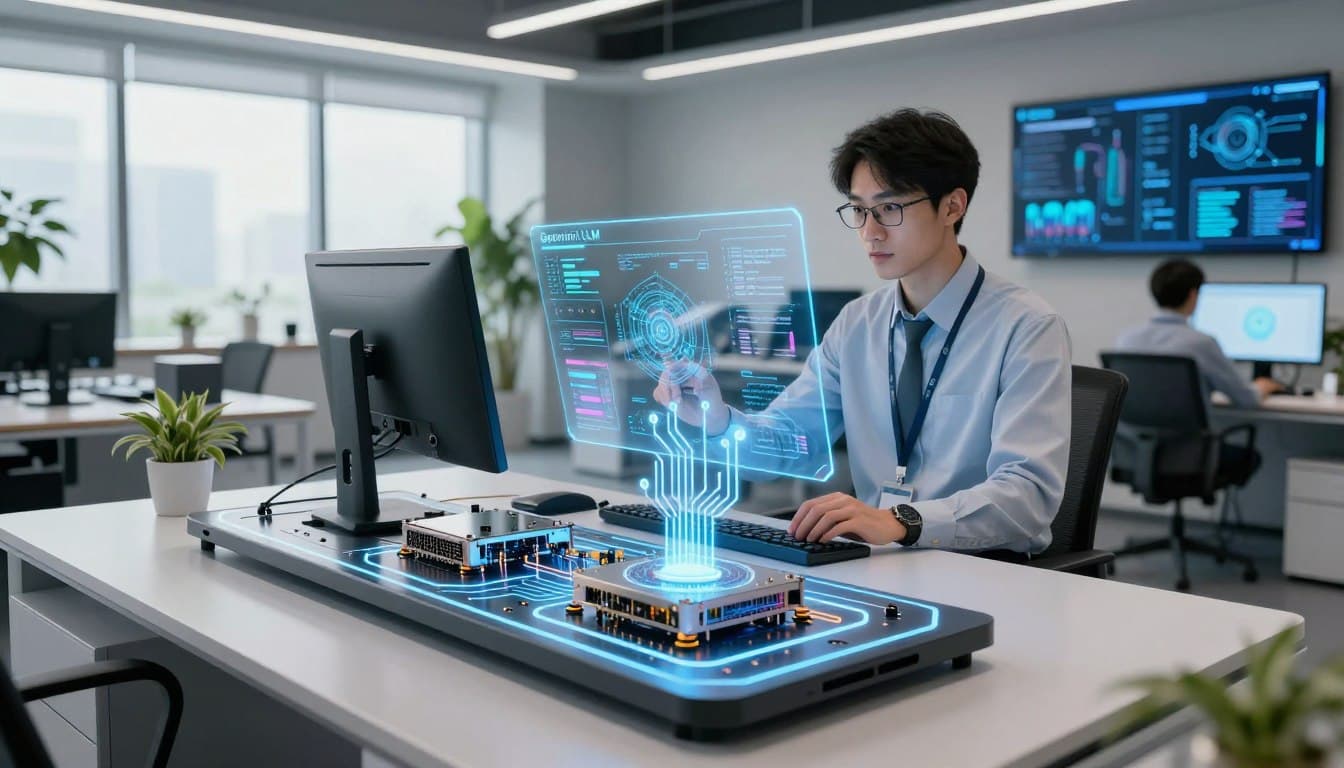
AI's Impact on Design: Gemini LLM Hardware Innovation
The advent of AI in design is revolutionizing the way we approach innovation, particularly with the emergence of Gemini LLM. This cutting-edge technology is transforming the landscape of hardware innovation, enabling more efficient and creative solutions.

As AI design continues to evolve, it's clear that hardware innovation is being driven by the capabilities of Gemini LLM. This synergy is opening new avenues for development, making it an exciting time for industries reliant on technological advancements.
Key Takeaways
- The integration of AI in design is enhancing innovation.
- Gemini LLM is a key player in the future of hardware development.
- AI-driven design is streamlining the development process.
- Hardware innovation is becoming more efficient and creative.
- The collaboration between AI and human ingenuity is driving progress.
The Convergence of AI and Modern Design Practices
The convergence of AI and design is opening new avenues for creative expression. As AI technologies become more integrated into design workflows, they are fundamentally changing how designers work and create. This shift is not just about adopting new tools, but about reimagining the design process itself.
How Artificial Intelligence Is Reshaping Creative Work
Artificial intelligence is reshaping creative work by automating repetitive tasks, providing intelligent suggestions, and enabling designers to focus on high-level creative decisions. AI-powered design tools can analyze vast amounts of data, learn from it, and apply those insights to improve design outcomes.
For instance, AI can help in generating initial design concepts, suggesting color palettes, and even predicting user preferences. This not only speeds up the design process but also enhances the quality of the final product.
The Role of Advanced Hardware in AI-Powered Design Tools
The effectiveness of AI-powered design tools heavily relies on advanced hardware capable of handling complex computations. High-performance processors, ample memory, and specialized hardware like GPUs and TPUs are crucial for running AI algorithms efficiently.
Advanced hardware enables smoother operation of AI-driven design software, allowing for real-time rendering, complex simulations, and faster iteration cycles. This hardware-software synergy is what makes modern AI-powered design tools truly powerful.
As AI continues to evolve, the demand for more sophisticated hardware will grow, driving innovations in both AI algorithms and the hardware that supports them.
Understanding Google's Gemini LLM Architecture
At the heart of Google's latest AI advancements is the Gemini LLM architecture, a sophisticated framework that is redefining the boundaries of multimodal processing. This architecture is designed to handle complex tasks that require the integration of various data types, including text, images, and other forms of media.
What Sets Gemini Apart from Previous Language Models
Gemini LLM distinguishes itself from previous language models through its advanced multimodal capabilities and scalability. Unlike earlier models that were primarily focused on text processing, Gemini can handle a wide range of data types, making it a versatile tool for various applications.
Key Features:
- Enhanced multimodal processing capabilities
- Scalability to meet different design needs
- Advanced integration of text and visual data
Multimodal Processing Capabilities for Visual and Text Integration
The multimodal processing capabilities of Gemini LLM enable seamless integration of visual and text data, allowing for more comprehensive and nuanced understanding of complex design elements. This capability is particularly valuable in applications where both visual and textual information are crucial.
"The ability to process and integrate multiple forms of data is a game-changer for design and development workflows, enabling more efficient and effective collaboration between humans and AI systems."
Gemini Ultra, Pro, and Nano: Tailored Solutions for Different Design Needs
Gemini LLM is offered in three variants: Ultra, Pro, and Nano, each tailored to meet different design needs and requirements. This tiered approach allows users to select the most appropriate version based on their specific needs, whether it's for complex enterprise applications or more straightforward design tasks.
| Gemini Variant | Design Needs | Key Features |
| Ultra | Complex enterprise applications | Advanced multimodal processing, high scalability |
| Pro | Professional design tasks | Balanced performance and efficiency |
| Nano | Basic design and development | Lightweight, efficient processing |
By offering these tailored solutions, Gemini LLM caters to a wide range of users, from professionals to hobbyists, ensuring that the benefits of advanced AI architecture are accessible to all.
Hardware Innovations Powering Gemini's Design Capabilities
The backbone of Gemini's design capabilities lies in cutting-edge hardware innovations. These advancements are crucial in enabling the complex computations required for AI-driven design processes.
Google's Tensor Processing Units: The TPU v5 Revolution
Google's Tensor Processing Units (TPUs), particularly the latest TPU v5, have revolutionized the field of AI and machine learning. These custom-built processors are designed to handle the intense computational demands of AI models, including those used in Gemini's design capabilities.
As Jeff Dean, Google Senior Fellow, notes, "TPUs have been instrumental in advancing the state of the art in machine learning, enabling us to train larger, more complex models."
Advanced Memory Systems for Handling Complex Design Data
The complexity of design data requires advanced memory systems that can handle large datasets efficiently. Gemini leverages cutting-edge memory technologies to ensure seamless performance.
- High-bandwidth memory for rapid data access
- Advanced caching techniques for optimized data retrieval
- Scalable memory architecture for handling growing dataset sizes
Optimized Processing Speed and Energy Efficiency
Optimizing processing speed while maintaining energy efficiency is crucial for sustainable design practices. Gemini achieves this through innovative hardware design and processing techniques.
Parallel Processing Architecture Benefits
Gemini's parallel processing architecture allows for the simultaneous handling of multiple design tasks, significantly boosting productivity. This architecture is particularly beneficial for complex design operations that require multiple computations.
| Processing Architecture | Benefits |
| Parallel Processing | Increased productivity, faster task completion |
| Sequential Processing | Simpler task management, potentially slower overall performance |
Reduced Carbon Footprint for Sustainable Design
By focusing on energy efficiency, Gemini contributes to sustainable design practices. The reduced carbon footprint is achieved through optimized hardware performance and intelligent power management.
"Sustainability is no longer just a buzzword; it's a critical component of modern design. By leveraging energy-efficient hardware, we can significantly reduce the environmental impact of our design processes." -
Design Industry Expert
As the design industry continues to evolve, the integration of hardware innovations like Google's TPUs and advanced memory systems will play a crucial role in shaping the future of AI-driven design.
Transforming Visual Design Workflows with AI
Visual design workflows are undergoing a significant transformation thanks to AI advancements. The creative process is becoming more streamlined, allowing designers to focus on high-level creative decisions rather than mundane tasks.
Intelligent Graphic Design and Brand Identity Creation
AI is revolutionizing graphic design by enabling the creation of sophisticated visual elements with ease. Intelligent design tools can now suggest color palettes, typography, and imagery based on brand guidelines, significantly speeding up the design process.
For brand identity creation, AI-driven tools can analyze existing brand assets and generate new design elements that are consistent with the brand's visual identity. This ensures coherence across all marketing materials and helps maintain a strong brand presence.
Automated Layout Generation and Design System Management
AI-powered automated layout generation is changing the way designers work. By analyzing content and context, AI can suggest optimal layouts for various design needs, from digital marketing materials to print media.
Design system management is also being transformed by AI. AI can monitor and maintain design consistency across large-scale projects, ensuring that all elements adhere to the defined design system. This reduces the manual effort required to keep designs consistent and up-to-date.
| Design Task | Traditional Method | AI-Assisted Method |
| Graphic Design | Manual creation of visual elements | AI suggests design elements based on brand guidelines |
| Layout Generation | Designers manually create layouts | AI generates optimal layouts based on content and context |
| Design System Management | Manual monitoring and updates | AI maintains design consistency across projects |
Instant Design Variations and A/B Testing Capabilities
AI enables designers to generate instant design variations, allowing for rapid experimentation and iteration. This capability is particularly valuable for A/B testing, where designers can quickly create multiple versions of a design to test with different audience segments.
By leveraging AI for A/B testing, designers can make data-driven decisions more efficiently, optimizing their designs based on real user feedback.
Revolutionizing User Experience and Interface Design
With AI-driven technologies, the landscape of user experience and interface design is undergoing a significant shift. Artificial intelligence is not just enhancing existing design practices but is fundamentally changing how we approach user experience.
AI-Driven Interface Recommendations Based on User Behavior
AI algorithms can analyze vast amounts of user data to provide insights into user behavior, enabling designers to create more intuitive interfaces. These AI-driven recommendations help in crafting user journeys that are more engaging and personalized.
Key benefits of AI-driven interface recommendations include:
- Enhanced user engagement through personalized interfaces
- Improved usability by adapting to user behavior patterns
- Data-driven design decisions for more effective user experiences
Personalization at Scale for Digital Products
AI enables personalization at scale, allowing digital products to offer unique experiences to individual users. This is achieved through complex algorithms that analyze user data and preferences to tailor the interface and content accordingly.
| Personalization Feature | Description | Impact on User Experience |
| Dynamic Content Adjustment | Content is adjusted in real-time based on user behavior | Higher user engagement due to relevant content |
| Customizable UI Elements | Users can personalize UI elements such as layout and colors | Improved user satisfaction through personalized interfaces |
Enhanced Accessibility Features Through Machine Learning
Machine learning algorithms can significantly enhance the accessibility of digital products by learning from user interactions and adapting to assist users with disabilities.
Examples of enhanced accessibility features include:
- Voice-controlled interfaces for users with mobility impairments
- AI-powered screen readers for visually impaired users
- Predictive text and auto-complete features for users with cognitive disabilities
Gemini's Impact on 3D Modeling and Product Design
Gemini's advanced capabilities are transforming the landscape of 3D modeling and product design. By leveraging AI-generated content, designers can now create complex 3D models with unprecedented speed and accuracy.

Rapid 3D Asset Generation and Modification
The ability to rapidly generate and modify 3D assets is a game-changer in product design. Gemini's AI algorithms can create intricate 3D models based on simple inputs, allowing designers to focus on the creative aspects rather than tedious modeling tasks.
Key benefits include:
- Reduced time-to-market for new products
- Increased complexity and detail in 3D models
- Improved collaboration between designers and engineers
Intelligent Parametric Design Optimization
Gemini's intelligent parametric design optimization capabilities enable designers to create products that are both functional and aesthetically pleasing. By analyzing various design parameters, Gemini can suggest optimal design configurations that meet specific performance criteria.
This results in:
- Enhanced product performance
- Reduced material waste
- Improved sustainability
AI-Generated Materials, Textures, and Lighting Solutions
The use of AI-generated materials, textures, and lighting solutions in 3D modeling is becoming increasingly prevalent. Gemini can generate realistic textures and materials based on real-world samples, and its lighting solutions can simulate complex lighting scenarios.
Advantages include:
- More realistic renderings
- Reduced need for physical prototypes
- Enhanced visualization capabilities
Real-Time Collaboration Enabled by Hardware Advancements
The advent of advanced hardware has revolutionized real-time collaboration in design teams. This significant leap forward is primarily driven by innovations in cloud-based design platforms, latency reduction, and efficient version control systems.
Cloud-Based Design Platforms Powered by Gemini Infrastructure
Cloud-based design platforms have become the backbone of modern design collaboration. Powered by Google's Gemini infrastructure, these platforms offer scalable, secure, and high-performance environments for design teams. The Gemini infrastructure enables seamless integration of various design tools and facilitates real-time collaboration across different geographical locations.
Minimized Latency for Distributed Design Teams
One of the critical challenges faced by distributed design teams is latency. Advanced hardware, particularly Google's Tensor Processing Units (TPUs), has significantly minimized latency, enabling design teams to work together in real-time without noticeable delays. This reduction in latency has enhanced productivity and streamlined the design process.
Seamless Version Control and Design History Management
Efficient version control and design history management are crucial for collaborative design projects. The latest hardware advancements have enabled the development of sophisticated version control systems that track changes in real-time, allowing team members to revert to previous versions if needed. This capability ensures that design teams can work collaboratively without conflicts, maintaining a clear and accessible design history.
In conclusion, the synergy between advanced hardware and cloud-based design platforms has transformed the landscape of real-time collaboration for design teams. By minimizing latency and providing robust version control, these innovations have set a new standard for collaborative design work.
Industry-Specific Applications Across Design Disciplines
The versatility of Gemini LLM is evident in its wide-ranging applications across various design disciplines. This advanced technology is not only enhancing existing design processes but also opening up new possibilities for creativity and innovation.
Architectural Visualization and Space Planning
In architectural visualization and space planning, Gemini is revolutionizing the way designers conceptualize and present their ideas. With its advanced capabilities, architects can now:
- Create highly detailed and realistic visualizations
- Generate multiple design iterations quickly
- Optimize space planning based on various parameters

The use of Gemini in architectural visualization is streamlining the design process, allowing for more efficient collaboration between architects, clients, and stakeholders.
Fashion Design and Digital Pattern Making
The fashion industry is also benefiting from Gemini's capabilities, particularly in design and digital pattern making. Designers can now:
- Generate complex patterns and designs with ease
- Create virtual prototypes, reducing the need for physical samples
- Experiment with various fabrics and textures virtually
Gemini is enabling fashion designers to push the boundaries of creativity while improving efficiency and reducing costs.
Gaming Assets and Interactive Entertainment Design
In the gaming and interactive entertainment sector, Gemini is being used to create more sophisticated and engaging assets. This includes:
- Generating detailed character models and environments
- Creating dynamic textures and materials
- Developing complex animations and interactions
The use of Gemini in gaming asset creation is allowing developers to focus more on the creative aspects of game design, enhancing the overall gaming experience.
Marketing and Advertising Creative Production
In marketing and advertising, Gemini is transforming the creative production process. Marketers can now:
- Generate high-quality visual content quickly
- Create personalized advertising materials
- Optimize ad designs based on performance data
The application of Gemini in marketing and advertising is enabling businesses to produce more effective campaigns while reducing production times and costs.
Navigating Challenges in AI-Assisted Design
With AI becoming more prevalent in design, the industry is confronted with the task of balancing technological advancement with human creativity. As AI-assisted design tools continue to evolve, designers and organizations must adapt to the changing landscape.
Adapting Design Skills for AI-Augmented Workflows
The integration of AI into design workflows necessitates a shift in the skill sets of design professionals. Designers must now be proficient in using AI-powered tools, understanding how to leverage AI to enhance their creative processes. This involves learning new software and methodologies, as well as adapting to the changing demands of the industry.
To effectively work with AI-assisted design tools, designers need to develop a deep understanding of how AI algorithms work and how they can be applied to various design tasks. This knowledge enables designers to maximize the potential of AI in their work, leading to more efficient and innovative design solutions.
Preserving Creative Vision and Human Touch
One of the significant challenges in AI-assisted design is maintaining the creative vision and human touch that are characteristic of human designers. While AI can process and analyze vast amounts of data, it lacks the emotional and intuitive aspects of human creativity. To address this, designers must learn to collaborate with AI systems in a way that preserves the essence of their creative vision.
By understanding the strengths and limitations of AI, designers can effectively integrate AI into their workflows, ensuring that the final product retains a human touch. This involves using AI as a tool to augment human creativity, rather than replacing it.
Addressing Cost, Access, and Implementation Barriers
The adoption of AI-assisted design tools also presents several practical challenges, including cost, access, and implementation barriers. Many organizations face difficulties in investing in the necessary hardware and software required to support AI-powered design tools.
To overcome these challenges, organizations can explore various strategies, such as cloud-based solutions that reduce the need for expensive hardware, or partnering with technology providers to gain access to cutting-edge AI tools. Additionally, providing training and support for designers can help ensure a smooth transition to AI-assisted design workflows.
Conclusion
The integration of AI design capabilities, powered by Gemini LLM and cutting-edge hardware innovation, is revolutionizing the design industry. As explored throughout this article, the impact of AI on modern design practices is multifaceted, transforming visual design workflows, user experience, and 3D modeling.
With the advent of advanced hardware, such as Google's Tensor Processing Units, design tools are becoming increasingly sophisticated, enabling real-time collaboration and intelligent design assistance. As AI continues to evolve, it is poised to play an even more significant role in shaping the future of design.
The future of design will likely be characterized by seamless human-AI collaboration, where AI handles complex tasks, freeing designers to focus on creative vision and strategy. As the design industry continues to adopt AI-driven solutions, professionals must adapt their skills to work effectively alongside AI, ensuring that the human touch is preserved in the design process.
Ultimately, the synergy between AI design, Gemini LLM, and hardware innovation will drive innovation, efficiency, and creativity in the design industry, opening up new possibilities for designers and businesses alike.