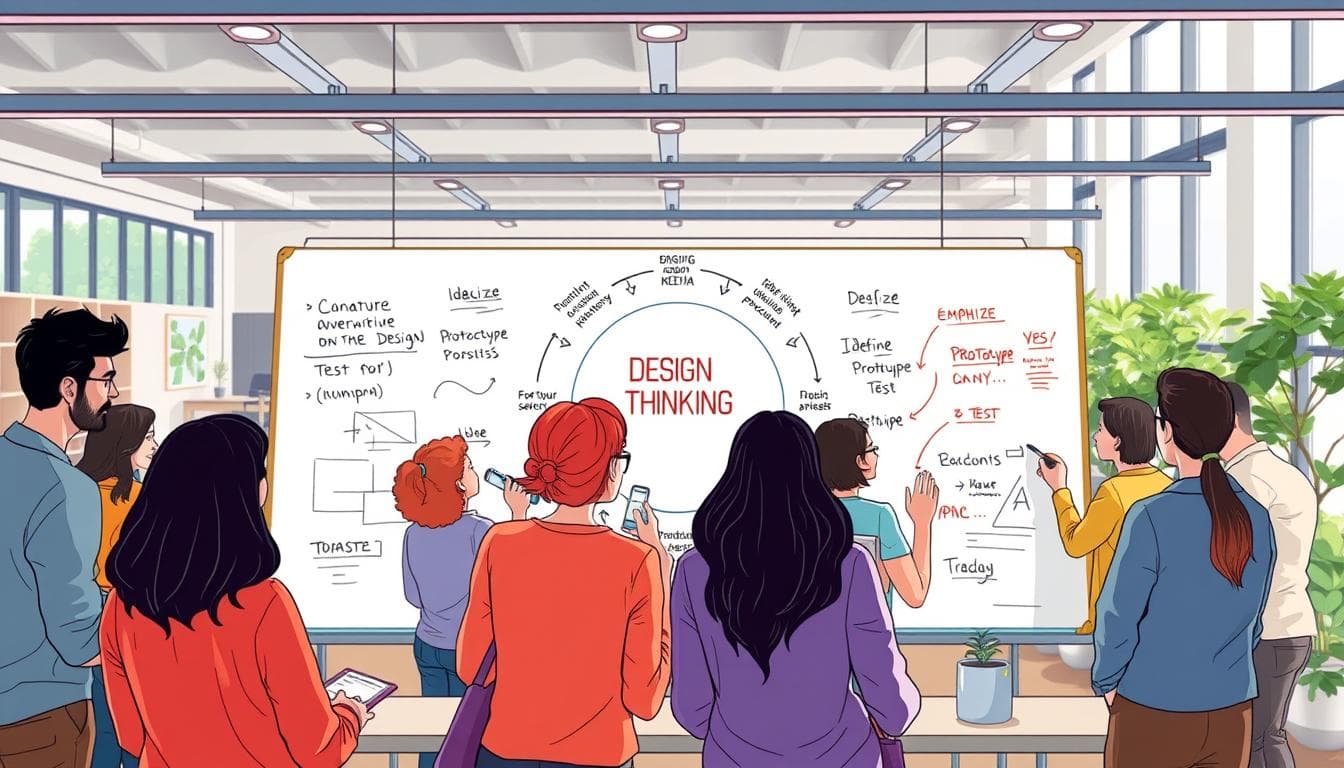
Design Thinking for Non-Designers: Unlock Your Creative Problem Solving
Anonymous
Design Thinking for Non-Designers: Unlock Your Creative Problem Solving
In today's fast-paced business environment, creative problem-solving is crucial for success. Design thinking has emerged as a powerful tool to drive innovation and solve complex problems.

This methodology, once confined to design teams, is now being adopted by non-designers across various industries. By embracing design thinking, individuals can cultivate a fresh perspective and develop innovative solutions to real-world problems.
Key Takeaways
- Understand the principles of design thinking and its application beyond design teams.
- Learn how to approach problems with a creative and innovative mindset.
- Discover the benefits of using design thinking in your work or personal projects.
- Develop skills to collaborate effectively with designers and other stakeholders.
- Apply design thinking to drive innovation and solve complex problems.
What is Design Thinking?
At its core, design thinking is a human-centered approach to innovation. It's a methodology that puts the needs and wants of users at the forefront of problem-solving, enabling organizations to develop creative and effective solutions.
The concept of design thinking has evolved significantly over the years. Originally rooted in the practices of designers, it has expanded to become a versatile tool used across various disciplines. This evolution has transformed design thinking into a powerful approach for tackling complex challenges in diverse fields.
The Evolution of Design Thinking
Design thinking has its roots in the design community, where it was used to create innovative products and services. Over time, its application has broadened, and it is now used in business, education, healthcare, and more. This widespread adoption is a testament to its effectiveness in driving innovation.
Core Principles That Drive Innovation
The core principles of design thinking include empathy, experimentation, and collaboration. By embracing these principles, organizations can foster a culture of user-centered thinking, leading to the development of solutions that truly meet user needs.
Why Design Thinking Matters in Today's World
In today's fast-paced and rapidly changing world, design thinking offers a valuable approach to problem-solving. It enables organizations to be more agile, innovative, and responsive to user needs, making it an essential tool for success in various industries.
The Five Stages of the Design Thinking Process
The five stages of design thinking provide a structured framework for creative problem-solving. This methodology is not just about creating innovative solutions; it's also about understanding the users and their needs.
Empathize: Understanding User Needs
The first stage, Empathize, is about gaining a deep understanding of the users and their needs. It involves conducting interviews, observations, and research to gather insights into the users' experiences and pain points.
Define: Framing the Right Problem
In the Define stage, the information gathered during the empathize stage is analyzed to define the problem statement. This stage is crucial in framing the right problem to solve.
Ideate: Generating Creative Solutions
The Ideate stage is where creativity comes into play. It involves brainstorming and generating a wide range of ideas without worrying about their feasibility.
Prototype: Building Tangible Representations
Prototype involves creating tangible representations of the ideas generated during the ideation stage. This stage helps in visualizing and testing the ideas.
Test: Learning from User Feedback
The final stage, Test, is about gathering feedback from users on the prototypes. This stage is crucial in refining the solution and ensuring it meets the users' needs.
| Stage | Description | Key Activities |
| Empathize | Understanding user needs | Interviews, observations, research |
| Define | Framing the right problem | Analyzing data, defining problem statement |
| Ideate | Generating creative solutions | Brainstorming, idea generation |
| Prototype | Building tangible representations | Creating prototypes, visualizing ideas |
| Test | Learning from user feedback | Gathering feedback, refining solutions |
Why Non-Designers Should Embrace Design Thinking
Design thinking is no longer confined to designers; it's a methodology that can benefit professionals across various disciplines. As Tim Brown, CEO of IDEO, once said, "Design thinking is a human-centered approach to innovation that integrates the needs of people, the possibilities of technology, and the requirements for business success."
Breaking Down Silos Between Disciplines
Design thinking encourages collaboration across different departments and disciplines. By working together, non-designers can leverage diverse perspectives to tackle complex problems more effectively. This interdisciplinary approach fosters a culture of innovation and creativity within organizations.
Enhancing Problem-Solving Capabilities
Embracing design thinking enables non-designers to enhance their problem-solving skills. It promotes a user-centered approach, encouraging professionals to empathize with users and understand their needs. As a result, solutions become more relevant and effective.
Building Empathy and User-Centered Thinking
Design thinking emphasizes the importance of empathy in problem-solving. Non-designers who adopt this methodology can develop a deeper understanding of their users, leading to more intuitive and user-friendly solutions. "Empathy is about understanding people, not just their needs, but their feelings, their frustrations, and their aspirations," notes Janice Fraser, a design thinking expert.
By integrating design thinking into their workflow, non-designers can drive innovation and improve outcomes in their respective fields.
Developing an Empathetic Mindset
To create user-centered designs, one must first develop an empathetic mindset that allows for a deeper understanding of user perspectives. This involves more than just understanding users; it's about connecting with them on a human level. Empathy is the cornerstone of design thinking, enabling designers and non-designers alike to craft solutions that meet real user needs.
Techniques for Understanding User Perspectives
Understanding user perspectives requires a combination of research techniques and a willingness to listen. Active listening is crucial, as it involves fully concentrating on what users are saying, understanding their concerns, and responding thoughtfully.
- Conducting user interviews to gather first-hand information about user needs and pain points.
- Observing users in their natural environments to understand their behaviors and challenges.
- Creating empathy maps to visualize user experiences and identify patterns.
Conducting Effective User Interviews
Conducting effective user interviews is both an art and a science. It requires preparation, the right questioning techniques, and the ability to listen actively. Open-ended questions are particularly useful, as they encourage users to share their thoughts and feelings in detail.
Creating Empathy Maps
Empathy maps are a powerful tool for visualizing user experiences. They help teams understand user needs, pain points, and motivations. By creating an empathy map, teams can identify patterns and areas for improvement that might not be immediately obvious.
Observational Research Methods
Observational research involves watching users in their natural environments to understand their behaviors and challenges. This can provide valuable insights that might not be captured through interviews or surveys alone.
| Research Method | Description | Benefits |
| User Interviews | In-depth, one-on-one interviews with users. | Provides detailed insights into user needs and pain points. |
| Observational Research | Watching users in their natural environments. | Offers insights into user behaviors and challenges in context. |
| Empathy Maps | Visual representation of user experiences. | Helps identify patterns and areas for improvement. |
By employing these techniques, individuals can develop a more empathetic mindset, leading to more user-centered and effective design solutions.
Problem Definition Strategies for Non-Designers
Defining problems effectively is a crucial step in the design thinking process that non-designers can master with the right strategies. It's about framing the challenge in a way that leads to innovative solutions. To achieve this, non-designers can utilize several key techniques.
Crafting Effective "How Might We" Questions
"How Might We" (HMW) questions are a powerful tool in design thinking. They help reframe problems into opportunities for innovation. By starting with "How Might We," you can create open-ended questions that encourage creative solutions. For instance, instead of saying "We need to reduce customer complaints," you could ask, "How Might We improve our customer service to reduce complaints?"
Using Point-of-View Statements
A Point-of-View (POV) statement is a concise description of the user's needs and challenges. It helps teams stay focused on the user's perspective. A well-crafted POV statement includes the user, their need, and the insight into their challenge. For example, "Our customer needs a way to track their orders easily because they are frustrated with the current slow process."
Problem Framing Techniques
Effective problem framing involves understanding the root cause of the issue. Techniques like the "5 Whys" can help drill down to the core problem. By repeatedly asking "why," you can uncover the underlying issue that needs to be addressed.
Prioritizing User Needs
Prioritizing user needs is essential in problem definition. It ensures that the solutions developed are user-centered. Techniques such as user interviews, surveys, and empathy maps can help identify and prioritize these needs. By understanding what matters most to the user, you can define problems that, when solved, will have the most significant impact.
Ideation Techniques Anyone Can Master
The art of ideation is not limited to designers; it's a skill that can be developed by anyone. Ideation is a crucial step in the design thinking process, enabling individuals to generate a wide range of creative solutions to complex problems.
Brainstorming Methods That Actually Work
Brainstorming is a powerful ideation technique that involves generating as many ideas as possible without worrying about their feasibility. To make brainstorming sessions effective, it's essential to encourage wild and ambitious ideas, avoid criticizing others' suggestions, and build upon each other's ideas.
Mind Mapping for Idea Generation
Mind mapping is a visual technique that helps individuals organize and connect their ideas. By creating a mind map, you can visually structure your thoughts and identify relationships between different concepts, leading to more innovative solutions.

The "Worst Possible Idea" Exercise
This exercise involves generating ideas that are intentionally bad or impractical. By doing so, you can overcome self-censorship and stimulate creative thinking, often leading to unexpected breakthroughs.
SCAMPER Technique for Innovation
The SCAMPER technique is an acronym that stands for Substitute, Combine, Adapt, Modify, Put to Another Use, Eliminate, and Rearrange. By applying these different perspectives to existing ideas or products, you can generate new and innovative solutions.
Simple Prototyping for Non-Design Professionals
Simple prototyping techniques can empower non-design professionals to visualize and test their ideas effectively. Prototyping is an essential step in the design thinking process, allowing individuals to bring their concepts to life and gather valuable feedback.
Paper Prototyping Basics
Paper prototyping is a low-cost and accessible method for creating tangible representations of ideas. It involves sketching out concepts on paper to visualize and interact with them. This technique is particularly useful for testing user interfaces and workflows.
Digital Tools for Quick Mockups
For those who prefer digital prototyping, various tools are available that require little to no design experience. Tools like Figma and InVision offer user-friendly interfaces for creating digital mockups quickly.
Storyboarding Techniques
Storyboarding is another effective method for prototyping, especially for service design and user experience. It involves creating a visual narrative of the user's journey, highlighting key interactions and pain points.
Role-Playing and Service Prototyping
Role-playing can be used in conjunction with storyboarding to prototype service interactions. This involves acting out scenarios to identify potential issues and areas for improvement.
By leveraging these simple prototyping techniques, non-design professionals can effectively communicate their ideas and iterate towards better solutions.
Testing and Iteration: The Heart of Design Thinking
Testing and iteration are crucial elements in the design thinking process, enabling innovators to refine their solutions based on real user feedback. This stage is where ideas are put to the test, and the feedback gathered is used to make necessary improvements.
Gathering Meaningful Feedback
Gathering meaningful feedback is about creating a dialogue with your users. It's essential to ask the right questions and listen actively to their responses. Effective feedback gathering involves creating prototypes that are tangible enough for users to interact with and provide insightful feedback.
Iterative Improvement Cycles
Iterative improvement cycles are at the core of design thinking. This involves a continuous loop of testing, gathering feedback, and making improvements. Each cycle brings you closer to a solution that meets user needs more effectively.
Analyzing Test Results Without Bias
When analyzing test results, it's crucial to remain unbiased. This means looking at the data objectively and being willing to make significant changes if necessary. Unbiased analysis ensures that decisions are based on user needs rather than personal preferences.
When to Pivot vs. When to Persevere
Deciding whether to pivot or persevere is a critical decision in the design thinking process. If user feedback indicates a significant issue with the current solution, it may be time to pivot and explore alternative solutions. However, if the feedback is positive, it's worth persevering and refining the solution further.
Applying Design Thinking Across Different Industries
As organizations strive for innovation, design thinking has proven to be a valuable methodology across different industries. Its user-centered approach allows businesses and institutions to tackle complex problems creatively.

Business Strategy
In the business world, design thinking is used to drive innovation and improve customer experiences. Companies like Apple and IBM have successfully integrated design thinking into their product development processes, resulting in groundbreaking products and services.
For instance, Apple's focus on user experience has led to the creation of intuitive and aesthetically pleasing products. IBM's adoption of design thinking has transformed its approach to software development, making it more user-friendly and accessible.
Education
In education, design thinking is being used to foster creativity and critical thinking skills among students. Educators are incorporating design thinking into curricula to encourage students to approach problems from multiple angles.
"Design thinking is not just about solving problems; it's about understanding the people you're solving for." - IDEO
Healthcare
The healthcare industry is also benefiting from design thinking. Hospitals and healthcare providers are using design thinking to improve patient care and streamline clinical workflows.
- Improving patient outcomes through better-designed medical devices
- Enhancing patient experience through empathetic care design
- Streamlining clinical processes to reduce errors
Personal Development
On a personal level, design thinking can be applied to improve individual problem-solving skills and foster a more innovative mindset. By adopting a design thinking approach, individuals can become more empathetic and creative in their personal and professional lives.
| Industry | Design Thinking Application | Benefits |
| Business | Innovation, product development | Improved customer experience, competitive edge |
| Education | Curriculum development, teaching methods | Enhanced creativity, critical thinking |
| Healthcare | Patient care, medical device design | Better patient outcomes, improved patient experience |
Essential Design Thinking Tools for Non-Designers
As organizations strive to innovate, design thinking tools have emerged as essential assets for non-designers to drive creative problem-solving. These tools facilitate a user-centered approach, enabling teams to collaborate effectively and develop innovative solutions.
Digital Collaboration Platforms
Digital collaboration platforms are vital for teams to work together seamlessly. Tools like Slack and Microsoft Teams enable real-time communication and file sharing, while platforms like Trello and Asana help in project management and task organization.
Visual Thinking Software
Visual thinking software aids in brainstorming and idea visualization. Tools such as Miro and Lucidchart provide digital whiteboarding capabilities, allowing teams to map out ideas and processes visually. This enhances creativity and ensures that all team members are on the same page.
Templates and Frameworks to Get Started
For those new to design thinking, templates and frameworks can be incredibly helpful. They provide a structured approach to the design thinking process. Mural and IDEO's Design Thinking Toolkit offer a variety of templates that can be used to guide the process.
Free Resources for Beginners
Beginners can start with free resources such as Canva for graphic design needs and Google Jamboard for digital whiteboarding. These tools are user-friendly and provide a great introduction to the world of design thinking.
Overcoming Common Challenges in the Design Thinking Process
Implementing design thinking can be challenging, but understanding common obstacles can help teams navigate them more effectively. As teams embark on this innovative approach, they often encounter several hurdles that can impede progress.
Dealing with Resistance to Change
One of the primary challenges is resistance to change. Team members may be accustomed to traditional methods and feel uneasy about adopting a new, iterative approach. To overcome this, it's essential to communicate the benefits of design thinking clearly and involve stakeholders in the process.
Managing Time Constraints
Time constraints are another common issue. Design thinking is an iterative process that requires time for empathy, ideation, and testing. Prioritizing tasks and setting realistic timelines can help manage these constraints effectively.
Avoiding Common Pitfalls
Teams should also be aware of common pitfalls, such as poorly defined problems or inadequate user testing. To avoid these, it's crucial to define problems accurately and conduct thorough user testing.
Building Support Among Stakeholders
demonstrating the value of design thinking through small, successful projects and involving stakeholders in the design process.
By understanding these challenges and implementing strategies to overcome them, teams can successfully integrate design thinking into their workflow, leading to more innovative and user-centered solutions.
Conclusion: Integrating Design Thinking into Your Daily Life
As we've explored throughout this article, design thinking is a powerful tool for creative problem-solving that can be applied in various aspects of daily life. By embracing the five stages of the design thinking process - empathize, define, ideate, prototype, and test - individuals can develop innovative solutions to complex problems.
Integrating design thinking into daily life enables individuals to approach challenges with a user-centered mindset, fostering empathy and understanding. This, in turn, leads to more effective and creative solutions. Whether in personal or professional contexts, design thinking can be a valuable asset in driving innovation and growth.
By adopting design thinking principles, individuals can cultivate a culture of experimentation and continuous improvement. As you move forward, consider how you can apply design thinking to your daily life, and start experiencing the benefits of creative problem-solving firsthand.